Submission on the 2027 budget bill
Seven proposals to Althingi's Budget Committee on security and defence appropriations
Cite this publication
Iceland has committed to spending 1.5% of GDP on defence-related purposes by 2035. Based on projected GDP for 2026, that corresponds to about ISK 77 billion a year. Security and defence spending will therefore rise by tens of billions of krónur in the coming years.
Varða’s recommendations fall into two groups. The first concerns the planning on which appropriations in this area rest, and how that planning is communicated. Varða stresses that the government should state clearly how investment in this area is to increase security, and transparent, credible communication of plans and threat assessments is central to that. These recommendations are consistent with the priorities of both the majority and the minority of the Budget Committee, which have repeatedly called for a comprehensive plan and a clearer breakdown of expenditure.
The second group concerns specific issues that Varða has examined over the past year and which, in Varða’s view, cannot wait.
Seven proposals
Clarity before the second reading. It should be set out which appropriations in the bill count as security and defence spending, and on what basis.
An annual overview with the budget. Work should begin on a dedicated annual overview of public-sector security and defence expenditure, drawing on how the other Nordic countries present it.
A costed long-term plan. A comprehensive, costed plan should be in place when the next fiscal plan is prepared, and should form the basis for future appropriations in this area.
Security stocks. Appropriations should be made to begin building security stocks, with fuel as the priority.
Merchant ships under the Icelandic flag. Appropriations should be made to prepare cooperation with the Faroe Islands on operating an Icelandic international ship register.
Special Unit of the National Commissioner of the Icelandic Police. Funding should be secured for the Unit’s posts that have already been authorised.
Responding to drones. The police should be guaranteed funding to respond to drones at airports, ports and other critical infrastructure.
Varða is grateful for the opportunity to submit comments on the budget bill for 2027.
Varða is an independent think tank on national security. It works to deepen knowledge of the field and broaden debate on it. To that end, it publishes analyses and holds events in Iceland and abroad that bring together people from politics, business, public administration and academia. This submission focuses on Treasury appropriations for security and defence.
1. Clarity
Documents that the Ministry for Foreign Affairs and the Ministry of Finance and Economic Affairs submitted to the Budget Committee between October 2025 and June 2026 give figures of ISK 10–49 billion for annual security and defence spending. The difference is partly explained by the figures covering different scopes, from a single budget programme of the Ministry for Foreign Affairs to estimated total public-sector spending.
The government itself acknowledges that it has not yet fully determined which expenditure counts as security and defence spending. A memorandum from the two ministries to the Budget Committee dated 19 May 2026 states: “In the coming period it will be necessary to analyse in more detail the expenditure that demonstrably falls under defence- and security-related matters.”
Both the majority and the minority of the Budget Committee have repeatedly raised this issue. The majority has stressed that “further expenditure and build-up must be based on careful planning, objectives for the nation’s security and the commitments Iceland has undertaken” and that “[c]areful preparation ensures that funds are put to the best possible use” (Parliamentary document 450/157).
The committee opinion of the third minority states that “it is possible to discern neither from the bill nor from the ministry’s answers how the stated objectives are to be achieved or what falls under defence-related tasks” (Parliamentary document 465/157). The opinion of the first minority points out that “it is fundamental that Althingi obtain a clearer picture of the premises of the objectives and how they are to be implemented” (Parliamentary document 459/157).
In Varða’s view, this lack of clarity has at least five consequences:
- The power of the purse is weakened. Althingi finds it difficult to prioritise funds when it is not clear where they go. As spending will rise by tens of billions in the coming years, it matters greatly that Althingi can track where the money goes and what it delivers.
- Figures can rise without capability increasing. If ever more existing expenditure is counted as defence-related, defence-related spending as a share of GDP can rise without any increase in preparedness or capability.
- Credibility with allies can suffer. Iceland has no armed forces, and its defence rests on allies coming to its assistance. It therefore matters particularly that Iceland is seen to deliver what is expected of it. The government has itself stressed caution in defining the expenditure, among other reasons “to maintain credibility with our allies” (the ministries’ memorandum of 19 May 2026). The Ministry for Foreign Affairs has also told the Budget Committee that “there are many indications that those criteria will be tightened” (the ministry’s reply of 27 November 2025). If expenditure now counted does not meet tightened criteria, the gap to the target could prove larger than assumed. Garðar Forberg, Iceland’s former representative to the NATO Military Committee, has pointed out that the government needs “to explain much better how it views this part of the commitments, not least the interplay between the 1.5 per cent and the 3.5 per cent” (Tímarit Vörðu (Varða’s journal), June 2026).
- Part of the expenditure falls outside the budget. The ministries’ memorandum of 19 May 2026 estimates public-sector spending on defence-related purposes in 2026 at ISK 48.9 billion. Of this, about ISK 6.5 billion is spending by municipalities and public companies. It is not clear what expenditure and projects lie behind that figure. This share falls outside Althingi’s power of the purse, yet it still counts towards Iceland’s commitment to its allies.
- The effect of increased funding cannot be assessed. As long as it is unclear which expenditure is counted, Althingi cannot assess whether increased funding translates into greater preparedness and capability.
Varða therefore considers it important that, before the second reading, it is set out which appropriations in the 2027 bill count as security and defence spending, and on what basis (recommendation 1). The ministries’ memorandum of 19 May 2026 states that they have “completed an analysis of Iceland’s expenditure falling within NATO’s definitions of defence-related expenditure”, in connection with Iceland’s first report to the Alliance. That analysis could serve as the basis for such a breakdown.
In the longer term, Althingi must receive such information every year. Varða recommends that work begin on a dedicated annual overview, published with the budget, of public-sector security and defence expenditure across policy areas and levels of government (recommendation 2). The expenditure is spread across many ministries, agencies, municipalities and public companies, and no comprehensive overview of it exists. The overview would also need to show which expenditure counts towards the 3.5% benchmark and which towards the 1.5% benchmark, so that both can be monitored.
Iceland can look to the other Nordic countries here. In Sweden, for example, the budget bill is accompanied by a table showing increased funding for civil protection across policy areas. Neighbouring states are also working out how expenditure under the 1.5% benchmark will be delimited and presented, and Iceland can learn from that work.
The parliamentary resolution on security and defence policy requires the minister to report to Althingi annually on the policy’s implementation. An annual overview with the budget would be a natural part of that reporting as regards appropriations.
2. Long-term plan
The parliamentary resolution on security and defence policy of 3 February 2026 states that the policy shall be “realistic and costed, and updated regularly following consultation with Althingi”. The ministries’ memorandum of 19 May 2026 states that the analysis of expenditure will make it possible “to formulate a long-term policy on how Iceland will meet its commitment to spend 1.5% of GDP on defence and security in 2035”. The fiscal plan for 2027–2031 states that work is under way “to formulate a comprehensive long-term plan for public contributions to defence and security relating to systemically important infrastructure”. That plan is limited to infrastructure, whereas the coming increase covers defence-related expenditure as a whole. Neither has yet been submitted to Althingi, despite repeated requests from Parliament, including from the Budget Committee.
Implications for appropriations
Two factors tie a long-term spending plan particularly closely to the budget process:
- The increase extends well beyond the fiscal plan period. According to the ministries’ memorandum, public-sector defence-related spending amounts to 0.92% of GDP in 2026 and will reach 1.0% in 2031. About 85% of the increase needed to reach 1.5% by 2035 therefore falls outside current plans. The committee majority has itself pointed out that the changes “would need to be made in stages and possibly over a longer period than the fiscal plan covers” (Parliamentary document 704/156).
- The financing affects other policy areas. The majority has pointed out that “in the long term, the stability rule means that if expenditure must rise by tens of billions of krónur for defence-related tasks, this must be offset by tax changes or by reprioritising other expenditure” (Parliamentary document 704/156). Without a plan, it is unclear what prioritisation decisions await Althingi.
In the other Nordic countries, defence appropriations rest on long-term plans with broad parliamentary support. The Norwegian Storting unanimously adopted a plan for 2025–2036 in June 2024. In Denmark, an agreement among a broad majority of parliamentary parties covers 2024–2033, and in December 2024 the Swedish parliament adopted a total defence decision for 2025–2030. In the same month, the Finnish Government presented a defence report, prepared in consultation with a cross-party group of MPs, which sets the course for personnel and funding into the 2030s.
Risk assessment, policy and plan
In neighbouring states, risk assessment underpins security policy, and the policy in turn shapes the long-term plan and appropriations. In Iceland the policy is in place, and under the parliamentary resolution its implementation is to “[take] account of threat assessment”. The explanatory memorandum to the resolution contains a three-page chapter on threat assessment, which describes the security environment in general terms but does not assess individual risk factors and their consequences. The National Security Council published a general assessment of the security situation and outlook in February 2021 and updated it in December 2022. Unlike the other Nordic countries, however, Iceland has not published a dedicated public threat assessment.
Iceland is building a new culture in security and defence, and that culture must have public support. The public needs to understand which risks are being addressed and why more money must be spent in this area. If spending rises substantially without the reasons being clear, it will reduce public trust in the build-up that is necessary and that Iceland has committed to its allies to undertake. A public risk assessment also enables municipalities, businesses and households to prepare for the risks that the government considers most pressing for society.
In the other Nordic countries, national risk assessments are published regularly, most recently in Sweden and Denmark in 2025 and in Finland in 2023 (an updated Finnish assessment is expected in autumn 2026). In Norway, the Directorate for Civil Protection (DSB) has published analyses of crisis scenarios since 2011. In addition, intelligence and security services in all four countries publish public threat assessments every year. This year, for example, Säpo in Sweden, Supo in Finland and PST and E-tjenesten in Norway published such assessments, and the Danish Defence Intelligence Service (FE) published its assessment of the threat from Russia on 24 September.
Good governance calls for the Icelandic government’s risk assessment, on which the long-term plan rests, to be published before the plan is presented.
Total defence requires wider involvement
Security and defence policy is meant to cover society as a whole, and the same applies to the plan based on it.
As Iceland has no armed forces, society’s preparedness rests largely on municipalities, companies that operate critical infrastructure, emergency responders and civil society organisations. These actors also bear part of the cost: the ministries’ memorandum of 19 May 2026 attributes about ISK 6.5 billion of defence-related expenditure in 2026 to municipalities and public companies. The fiscal plan also states that the plan it describes will “rest on a coordinated approach between government, municipalities and public companies”.
Such an approach requires these actors, not least companies that operate systemically important infrastructure, to be involved early, in both analysis and planning, rather than only receiving the plan for comment once it is complete. That also supports better management of public funds. When the state, municipalities and companies plan together, it becomes more likely that state appropriations are used where the need is greatest, that duplication is avoided, and that it is clear who bears which costs before decisions are taken.
Follow-up
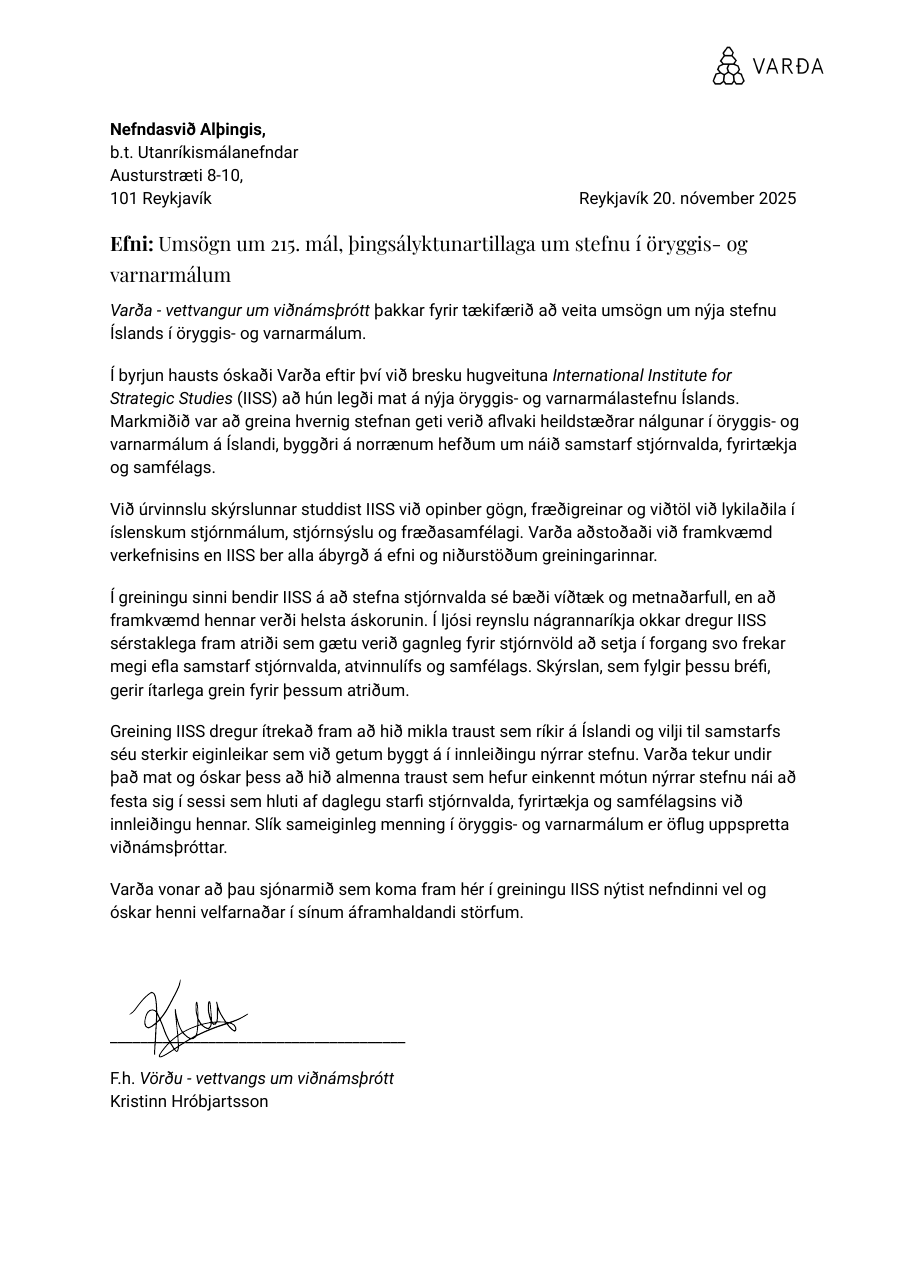
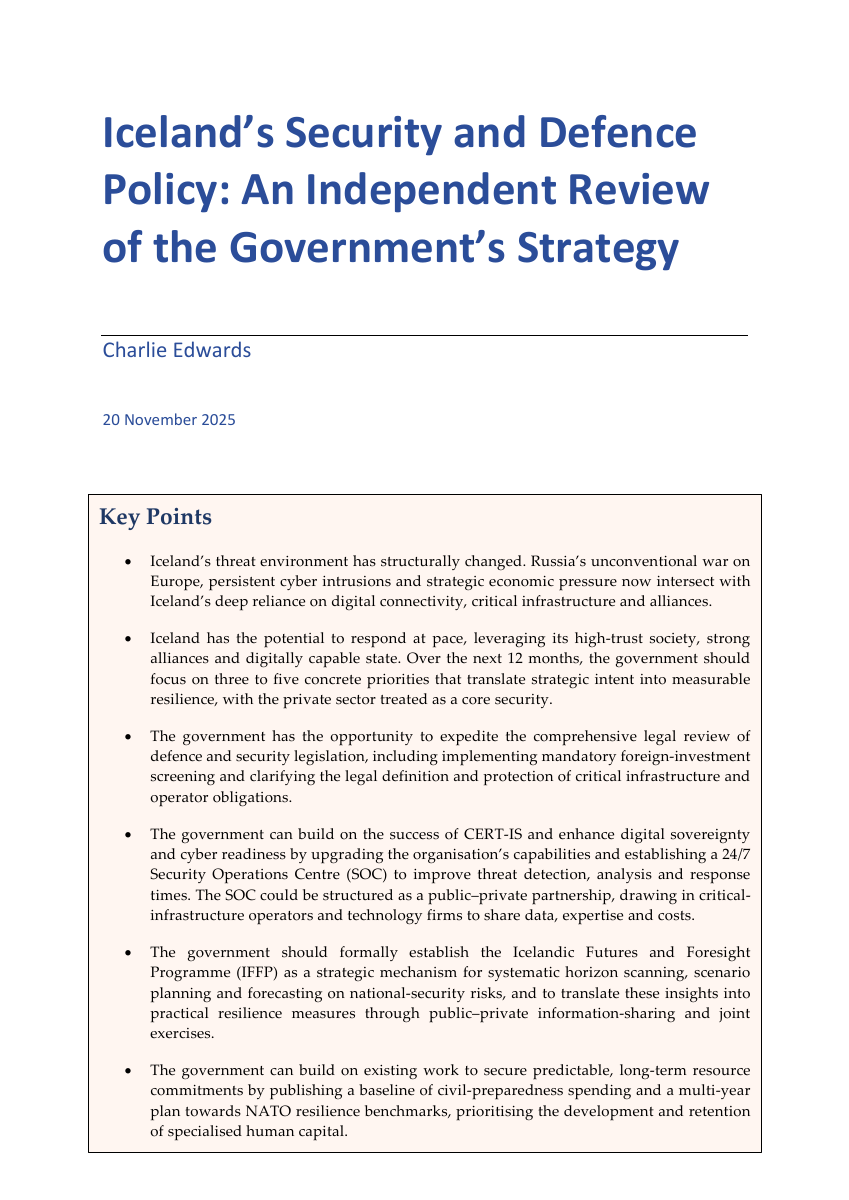
An assessment that the International Institute for Strategic Studies (IISS) prepared for Varða finds that implementation of the policy will be the main challenge. The IISS recommends that the government publish an overview of current spending on civil preparedness, together with a three-year plan for meeting NATO’s resilience baseline requirements. Under its proposal, the National Security Council would be given clear ownership of the plan, and a dedicated unit would be tasked with following it up and reporting publicly on its progress every quarter. In the IISS’s view, Iceland can make rapid progress if it reduces the number of priorities, gives the National Security Council responsibility for delivering them and assesses results regularly.
The proposal fits well with the Council’s statutory role. Under Act No. 98/2016, the National Security Council oversees the implementation of the National Security Policy for Iceland and shall report to Althingi on it annually. A long-term plan to 2035 substantially expands the scope of this role, and it is uncertain whether the Council currently has the staff and funding needed to carry it out.
Whichever route is chosen, what matters most is that follow-up is regular and public. The Budget Committee can then assess, when preparing each year’s budget, whether previous appropriations have delivered the intended capability.
Varða therefore considers it important that a comprehensive, costed plan be in place when the next fiscal plan is prepared, and that it form the basis for future appropriations in this area (recommendation 3). The plan should cover security and defence expenditure as a whole, so that the plan for systemically important infrastructure becomes part of it. It should rest on a public risk assessment and be developed with municipalities, businesses and civil society organisations from the outset. It should set out cost estimates and phasing to 2035, the division of expenditure between the 3.5% and 1.5% benchmarks and between policy areas and levels of government, and how the expenditure will be financed. It should also state who is responsible for follow-up, and progress on the plan should be reported publicly at regular intervals.
3. Tasks that cannot wait
The preceding sections discuss the information and planning on which appropriations in this area need to rest. Some tasks, however, cannot wait for a long-term plan. Over the past year, Varða has identified four such tasks. In most of them, the need has been known for years without funding being secured to address it.
Security stocks
In the past five years, global supply chains have suffered three major shocks: the COVID-19 pandemic, Russia’s invasion of Ukraine and the conflict in the Persian Gulf. Varða’s analysis Allt er þegar þrennt er (Third Time’s the Charm), published in May 2026, finds that Iceland has nonetheless not invested systematically in data collection on stock levels, supply-chain resilience or the build-up of security stocks. The Ministry of Industries has pointed out that oil is “by far the most important imported input to domestic food production” and that stocks of other inputs are of little use without it.
In 2022, a working group under the Prime Minister’s Office proposed that a single body be given overall responsibility for the country’s emergency stocks, and that a minimum of 90 days of fuel stocks be set in law, the same standard that the European Union and the International Energy Agency require. According to an analysis by the National Energy Authority, published in the working group’s report, accessible stocks at the end of each year have covered about 20–50 days of fuel demand, and jet fuel stocks have at times fallen below ten days.
In March 2026, the Minister of the Environment, Energy and Climate told Althingi that 90 days of fuel stocks were “fundamental in the short term”. He also noted that they could not be built up in one go, “at a cost of billions”, and expected a bill on the matter to be introduced in the legislative session now under way. The 2027 budget bill, however, makes no provision for funding the build-up. It lists “[a]nalysis and design of the financing and arrangements for security stocks of fossil fuels” among the ministry’s tasks, without additional appropriations.
Varða recommends that appropriations be made to begin building security stocks, with fuel as the priority (recommendation 4). The build-up needs to be able to start next year, since another year of analysis would be too long a wait in precarious times. Varða’s analysis identifies options that do not require the state to own the stocks itself, such as agreements with companies on increased stockholding, and loan guarantees. Whichever option is chosen, funding must accompany the bill the minister has announced.
Merchant ships under the Icelandic flag
Security stocks are of limited use unless goods can be relied on to reach the country. More than 90% of Iceland’s goods trade goes by sea, yet no merchant ship is registered in Iceland. The ships of Icelandic shipping companies sail under Faroese, Norwegian, Dutch and other foreign flags, and in times of crisis a flag state can call ships under its flag into service for its own needs. The Icelandic government has no such powers. Neighbouring states are already preparing to requisition property in an emergency. In January 2026, for example, the Norwegian Armed Forces sent about 13,500 notices to owners of vehicles, machinery, boats and real estate stating that their property could be requisitioned in wartime.
Two attempts to establish an Icelandic international ship register have failed. A tax incentive was repealed in 2011 after the EFTA Surveillance Authority raised concerns, and a draft bill from 2021 did not pass. Varða’s analysis Flotinn sem fór (The Fleet That Left), published in March 2026, proposes an agreement with the Faroese Maritime Authority to operate an Icelandic register, on the model of the world’s largest ship registers. Iceland would set the legal framework and retain jurisdiction and emergency powers, but would entrust day-to-day operation of the register to an agency that Icelandic shipping companies already know and trust. This approach requires neither that the state acquire ships nor that a new agency be built up.
NATO’s baseline requirements for resilience cover transport, among other areas. Action of this kind therefore increases real preparedness in an area that the 1.5% benchmark is meant to cover. Varða recommends that appropriations be made to prepare cooperation with the Faroe Islands on operating an Icelandic international ship register (recommendation 5).
Special Unit of the National Commissioner of the Icelandic Police
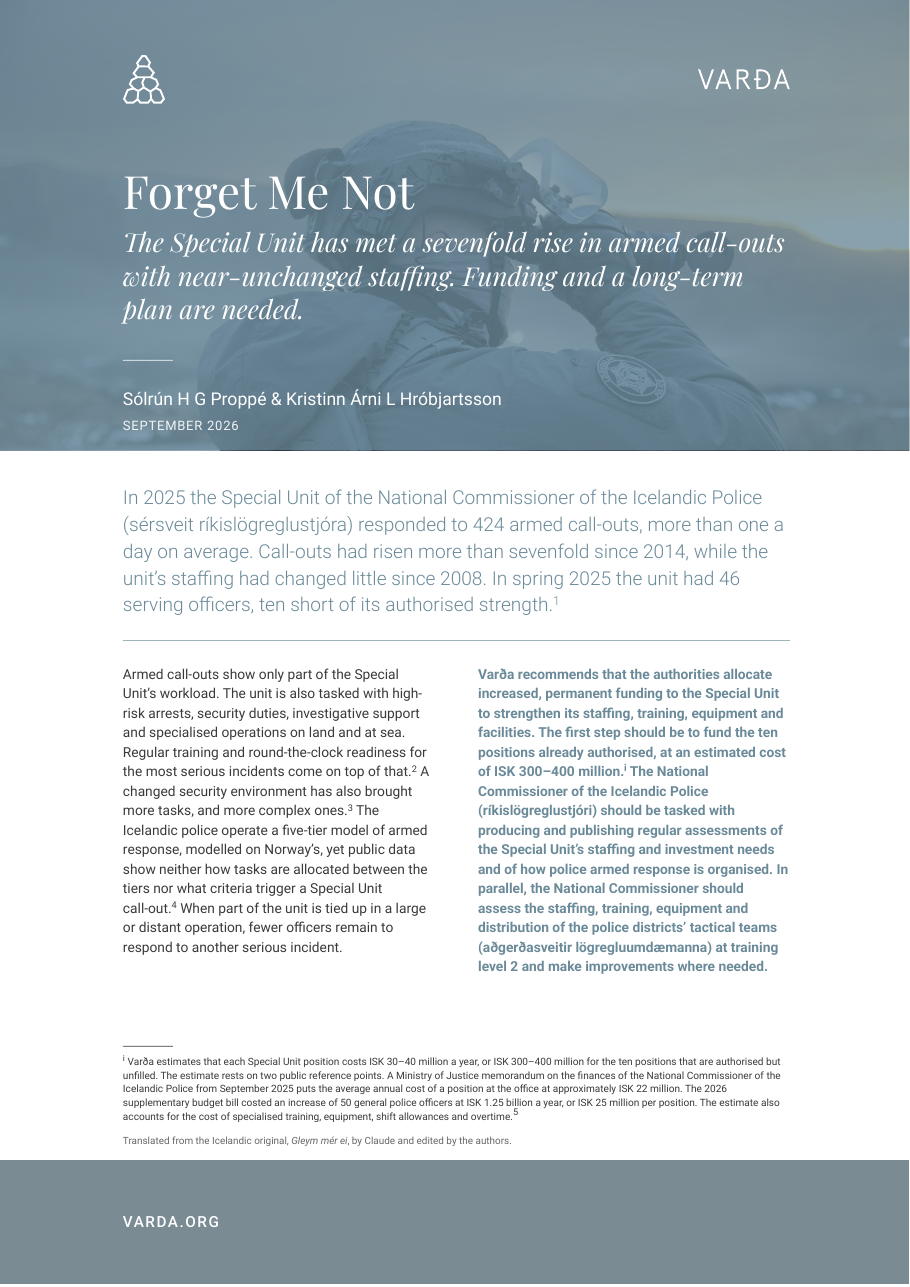
Varða’s analysis Gleym mér ei (Forget Me Not), published in September 2026, shows that the Special Unit’s armed call-outs rose from 56 in 2014 to 424 in 2025, or from about one a week to more than one a day on average. Staffing has changed little over the same period. In spring 2025, the Unit had 46 officers, ten fewer than authorised. For years, the National Commissioner of the Icelandic Police has pointed out to the government that the authorised posts must be funded, and in September the Minister of Justice said that the Unit could easily number 70–80.
Armed call-outs show only part of the workload. The Unit also handles dangerous arrests, protective security and specialised operations on land and at sea. In July 2026, together with the Icelandic Coast Guard’s special operations unit, it boarded the vessel Bandero and took control of it. When part of the Unit is tied up in a prolonged or distant operation, fewer officers are available to respond to another serious incident elsewhere in the country. The analysis also notes that sabotage, cyberattacks and other criminal acts that have been linked to foreign states have multiplied in Europe, and that the response to such incidents will rest largely on specially trained units such as the Special Unit.
Lack of funding has already held back the Unit’s development. In spring 2025, its recruit course was cancelled for that reason, even though about 25 police officers had been assessed as qualified to take part. The course was later held after a special appropriation by Althingi, but only two of those who completed it were hired into the Unit, and the total number of officers did not increase.
The 2027 budget bill increases the appropriation for law enforcement to fund more police officers, but does not state whether any of it will go to the Special Unit. Varða recommends that funding be secured for the Unit’s posts that have already been authorised (recommendation 6). Varða estimates the cost at about ISK 300–400 million a year, based on Ministry of Justice and budget-preparation benchmarks for the cost of police posts. That would be a first step towards the size the minister has mentioned.
Responding to drones
Drone incidents at airports, ports and other critical infrastructure have increased substantially in Europe. Last year, drones of unknown origin caused airport closures in countries including Denmark, Norway and Germany. The Danish Defence Intelligence Service’s threat assessment of 24 September states that Russia is now using drones against targets in Europe and will intensify its hybrid warfare further.
Varða’s analysis Að finna og fæla (Detect and Deter), published in June 2026 in cooperation with the Brooks Tech Policy Institute at Cornell University, notes that drone incidents at Keflavík Airport have drawn attention in Iceland. It identifies gaps in response systems: responsibilities are unclear, the response when incidents occur is inadequate, and coordination among those responsible for critical infrastructure is limited. It also notes that Iceland’s geographic isolation and limited redundancy may make the consequences of disruption more severe here than in many other parts of Europe.
Neither the 2027 budget bill nor the fiscal plan for 2027–2031 mentions responding to drones. Varða recommends that the police be guaranteed funding to respond to drones at airports, ports and other critical infrastructure (recommendation 7).
Varða thanks the Budget Committee for considering this submission. Varða’s representatives are ready to appear before the committee and explain its content in more detail, should the committee find this useful.